Writing techniques are deliberate methods writers use to make ideas clearer, more engaging, and more persuasive. They include sentence-level tools, such as parallelism, and broader strategies, such as point of view, structure, imagery, and argumentation.
These techniques can help you write a stronger college essay, personal statement, research paper, or even an email to your professor.
In this guide, you will learn how common writing techniques work, when to use them, and how to apply them without making your writing sound forced.
If you need help turning your ideas into a clear paper, our college essay help online lets you choose an expert and discuss every detail directly.
Writing techniques are methods that help writers share ideas in a clear and effective way. They can make a text easier to follow, more convincing, or more engaging.
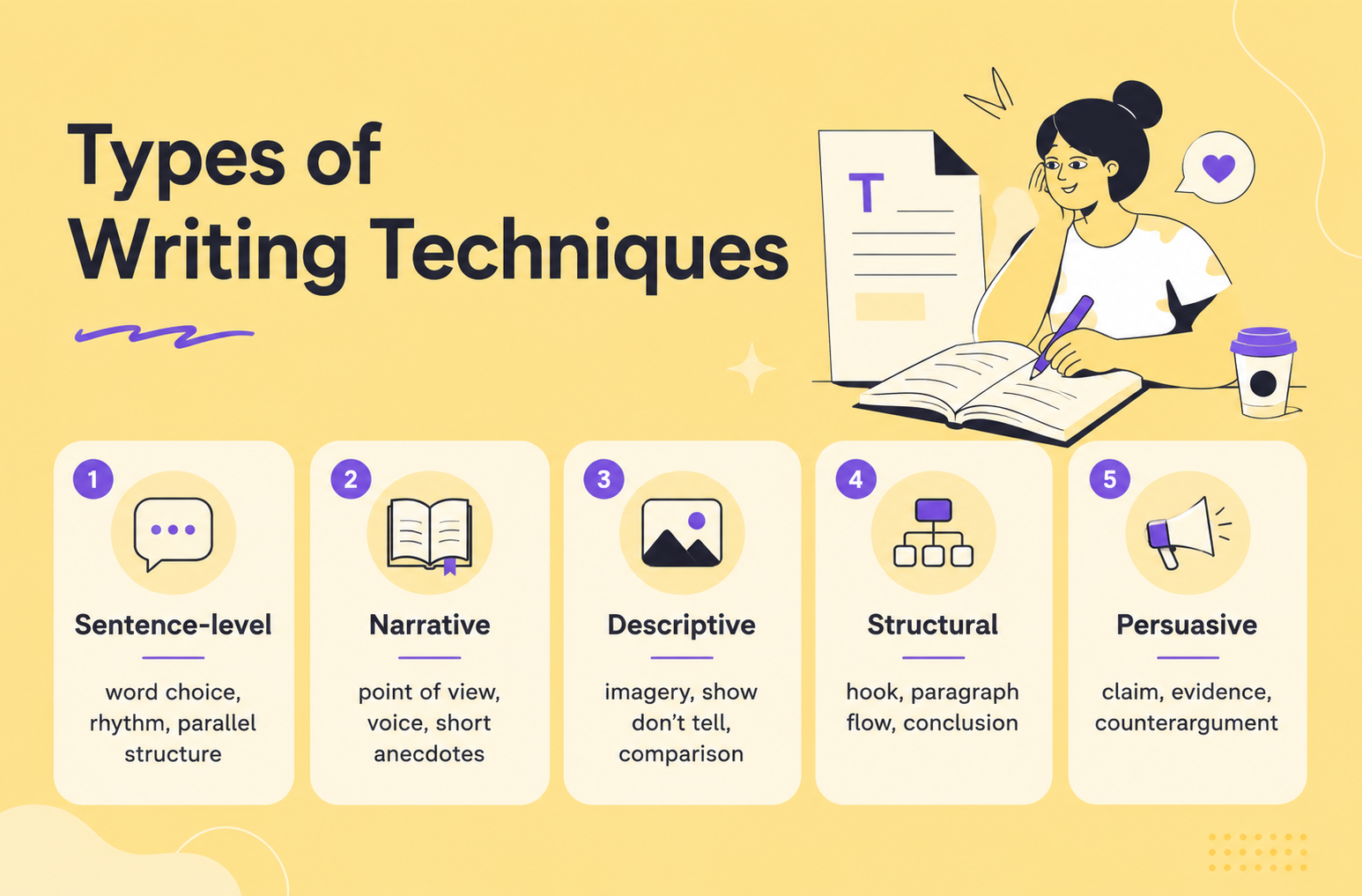
Common techniques in writing include:
Here is a simple example:
The second sentence does not simply say that the student feels nervous. It shows the feeling through actions. This is one of the most common writing techniques examples.
Different writing techniques can work at three levels:
Writing techniques are not the same as writing style. A technique is one tool you use. Your style is the overall way you combine different writing methods across a text.
Good writing helps people understand your ideas faster. It can make an essay clearer, a personal statement stronger, and an email more professional.
Useful techniques can help you:
For example, a student may have strong ideas but present them in a weak order. A clearer thesis, better transitions, and focused paragraphs can make the same essay much easier to follow.
Writing techniques also help outside the classroom. You may use them in job applications, reports, messages, or posts. The format may change, but the goal stays the same: share your point in a clear and effective way. These skills are especially useful when following a structured term paper writing process, where clear arguments, logical organization, and strong transitions can affect the quality of your final paper.
Creative writing techniques are not only for stories and poems. They can also make an essay clearer, more vivid, and easier to remember.
Instead of naming an emotion or problem, show it through actions or details.
The second version helps the reader picture the moment.
Imagery uses details linked to sight, sound, smell, taste, or touch.
For example, instead of writing “food was scarce,” you could describe a family sharing one small loaf of bread. This gives the reader a clearer sense of the situation.
Comparisons can make hard ideas easier to understand.
For example, you might compare the immune system to a security team. Both detect threats and respond to danger.
Use these tools with care in academic work. They should explain an idea, not replace facts or evidence. In a formal paper, clear reasoning should always come first.
Narrative techniques help writers tell a story and guide the reader. They include point of view, voice, dialogue, and short personal examples.
Many writing techniques in literature can also work in essays. They are useful in personal statements, reflective papers, case studies, and introductions.
| Point of view | Example | Best used for |
|---|---|---|
| First person | “I noticed that the results did not match my idea.” | Personal essays and reflection papers |
| Second person | “You open the report and see the problem at once.” | Guides and blog posts |
| Third person | “The researcher found a clear change in the results.” | Reports and formal papers |
First person feels personal and direct. Third person often sounds more formal. Second person speaks to the reader, so it works best in guides.
A short story or personal example can make an introduction more engaging. It can also show why a topic matters.
Keep it brief and relevant. The story should support your main point, not distract from it.
Your voice is the natural way you explain ideas. It grows as you write, revise, and test new approaches.
Do not try to copy another writer’s style. Focus on clear words, honest examples, and a tone that fits the task.
Clear writing often starts with a clear sentence. Shorter and more direct sentences help readers follow your point without going back over the same line.
Long phrases can hide the main idea.
The shorter version says the same thing in fewer words.
Items in a list should follow the same grammar pattern.
Parallel structure makes a sentence easier to read.
Use a mix of short and longer sentences. Short sentences add focus. Longer ones can explain details or show how ideas connect.
Avoid using the same sentence pattern again and again. It can make even a strong argument feel dull.
Strong sentences are not enough if the whole paper feels hard to follow. A clear structure helps readers understand your ideas and see how they connect.
Most essays have three main parts:
For example, an argumentative essay about social media and mental health could follow this plan:
Each paragraph should also follow a clear order. Start with one main point, support it with evidence, and explain how it connects to your argument.
Transition words such as “however,” “for example,” and “as a result” can help readers move from one idea to the next.
You can also link the conclusion back to the opening. This gives the essay a clear sense of closure.
A strong argument needs more than a clear opinion. It should also explain why that opinion makes sense and support it with evidence.
A simple argument has four parts:
For example, if you argue that online classes should include more live discussion, you could use student survey results as evidence. You could also explain how limited interaction affects motivation and learning.
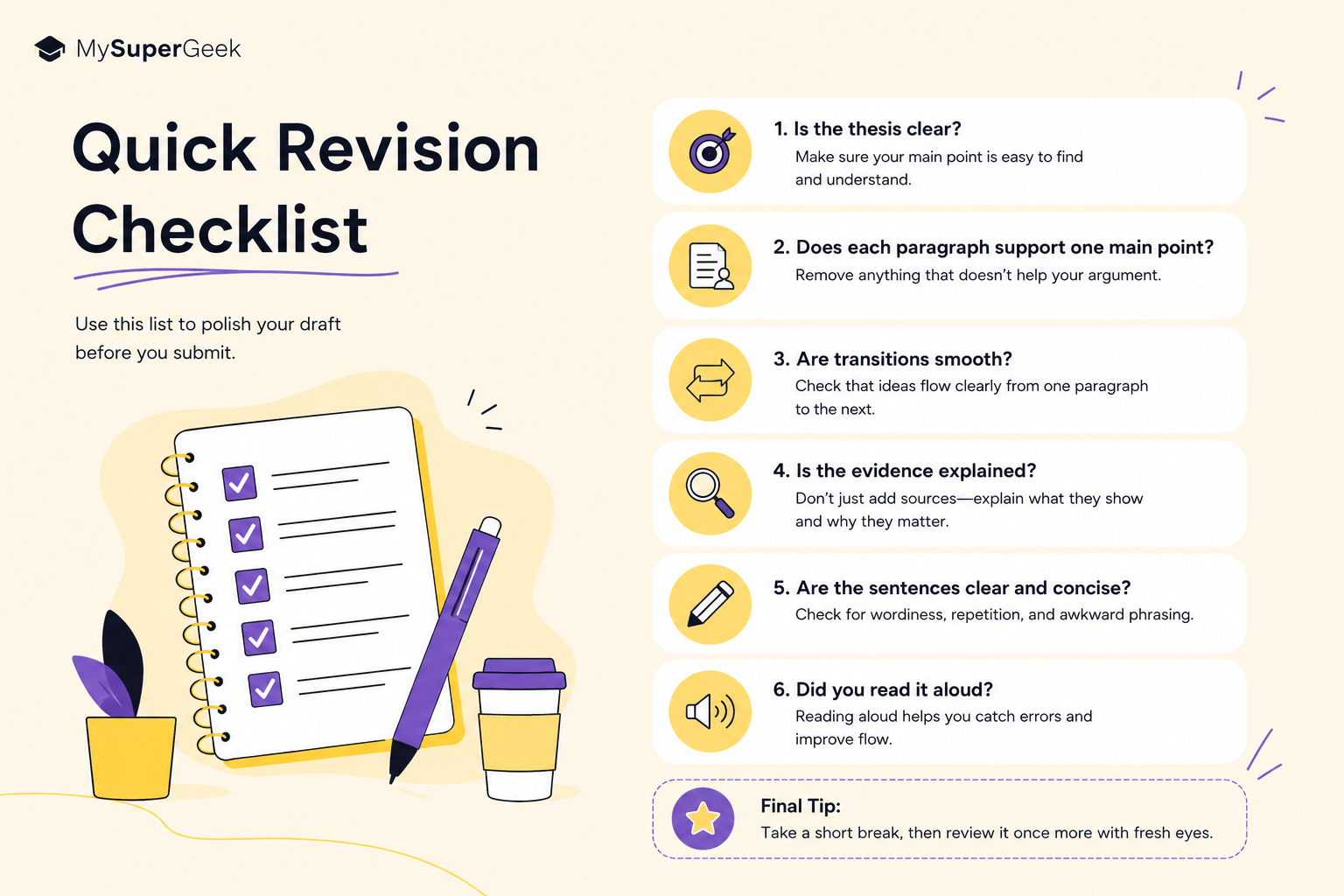
Do not add a quote or statistic without comment. After each source, explain what it shows and how it supports your point.
Emotional appeal can also help when it shows the real effect of an issue. Still, facts should come first. A personal example should support the argument, not replace evidence.
A first draft does not need to be perfect. Its main purpose is to get your ideas on the page. Revision comes next.
It is easier to revise a paper in two steps.
|
Step |
Main focus |
What to check |
|---|---|---|
|
First review |
Big problems |
Thesis, structure, point of view, and argument flow |
|
Second review |
Small details |
Word choice, sentence structure, transitions, and tone |
For a longer research paper, you can spread the work across three days:
You can also create a short outline from your finished draft. Write the main point of each paragraph in one line. This will help you spot repeated ideas or sections that do not fit.
Do not try to fix everything at once. Start with the main ideas, then move to sentence-level details.
Reading about a method is useful, but practice is what helps it stick. You do not need long daily sessions. Even 10–15 minutes can help you improve.
Try these exercises:
Keep a short note of what you changed and why. Over time, you will see which methods help your writing most.
You can also ask a classmate, tutor, or writing center for feedback. Be specific. Instead of asking, “Is this good?” try questions such as:
Clear questions often lead to more useful feedback.
Good writing takes practice. The more you revise, test new methods, and notice what works, the easier it becomes to express your ideas clearly.
Your writing voice will grow over time. It comes from your word choice, tone, structure, and the way you explain a point. You do not need to master everything at once. Start with one area, such as clearer sentences, stronger examples, or better transitions.
Read your work aloud, ask for feedback, and keep improving each draft. Small changes often make the biggest difference.
When you need extra assignment help, MySuperGeek lets you choose an expert, discuss your task directly, and request revisions before approval.
Writing techniques are tools that help writers share ideas clearly. They include word choice, sentence structure, imagery, point of view, transitions, and argumentation.
The main types include sentence-level, narrative, descriptive, persuasive, and structural techniques. Each type supports a different goal, such as explaining an idea, telling a story, or building an argument.
A writing technique is a specific tool, such as imagery or parallel structure. Writing style is the overall way a person uses words, tone, and sentence patterns.
Clear structure, strong examples, evidence, transitions, and direct wording work well in academic essays. Creative tools can also help, but they should not replace facts or analysis.
Practice one skill at a time. Rewrite old paragraphs, read your work aloud, ask for clear feedback, and compare each new draft with the first version.
Can’t handle all the homework?
Geeks are here 24/7 and can help you make the most out of your study time!