Services
Assignment & Homework Help
Writing & Academic Tasks
About us

To write a term paper, start with a focused topic, then research it, build an outline, and draft each section in order: introduction, body, and conclusion. Following a clear process helps you organize your research, develop stronger arguments, and avoid major revisions later.
A term paper tests more than your writing skills. It shows how well you can research a topic, build an argument, and present it clearly. That sounds like a lot, but once you split the work into stages, none of it feels overwhelming.
This term paper step-by-step guide walks you through every stage, from choosing your topic to formatting your final draft. You'll also find a full example, tips on academic writing faster, and answers to common questions students have.
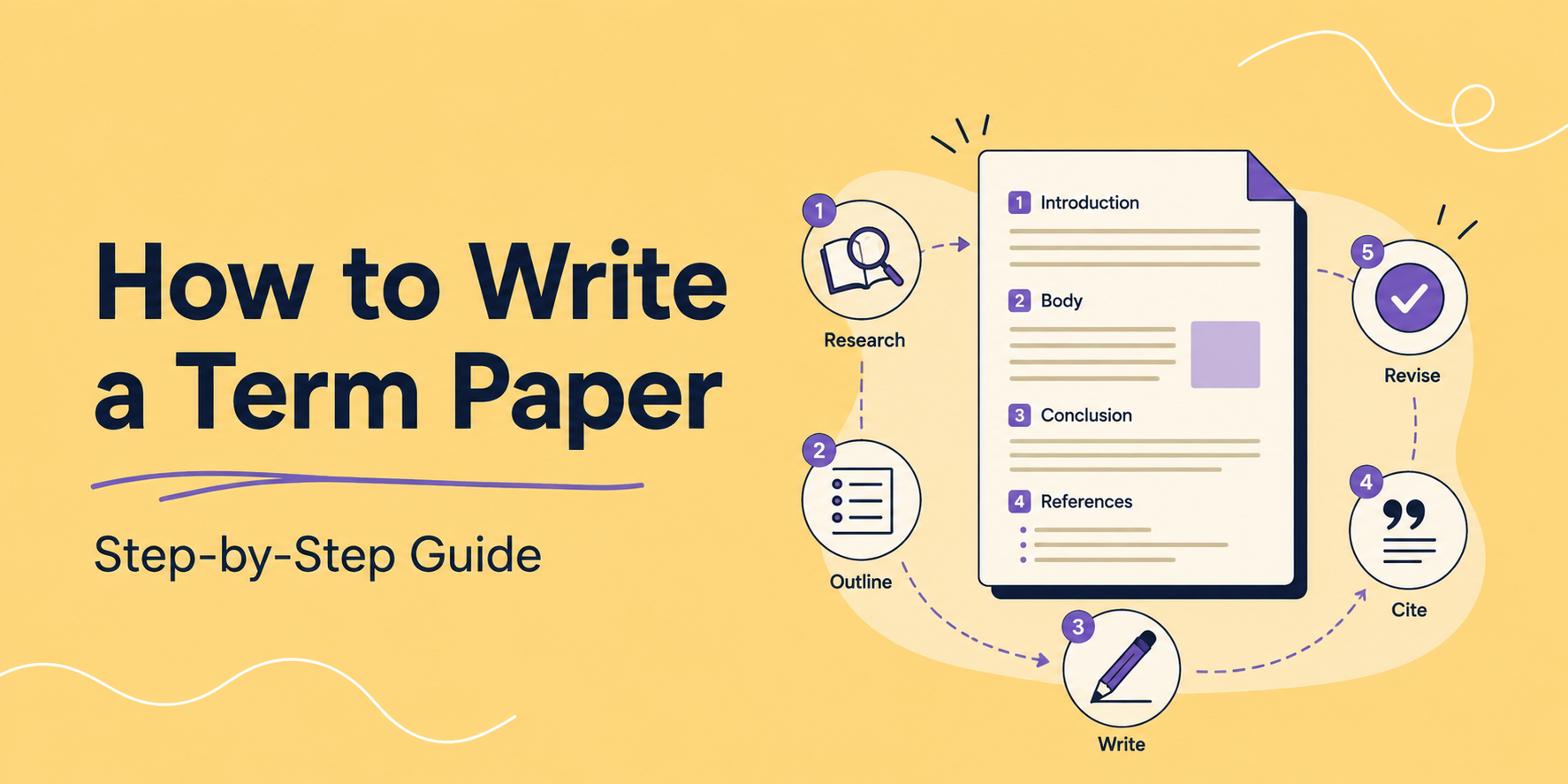
A term paper is a research-based assignment you write near the end of a course. It usually counts for a big part of your final grade, so professors expect more depth than a regular essay. You pick a topic tied to the course, research it, build an argument, and present your findings in a clear structure.
Term papers come in different forms. Some ask you to analyze a topic piece by piece. Others want you to argue a position, describe something in detail, or compare two ideas side by side. Your assignment sheet usually tells you which type fits.
Why does this assignment matter? It trains skills you will use again and again: reading academic sources, building an argument, and organizing long pieces of writing. Students who master this process find longer projects like a thesis far less intimidating.
If you want to know how to write a good term paper, start here: understand the assignment before you touch your research. A clear grasp of what's expected saves hours of rework later.
If you need additional support with your project, you can buy a term paper from a qualified writer who understands your subject requirements and deadline. Choose a writer, discuss your instructions directly, and review the work before releasing payment.
Once you understand the assignment, the real work starts. Below is the process broken into clear stages, from reading the prompt to submitting your final draft. Follow them in order, and each stage will feel manageable on its own.
Before you open a blank document, read the assignment requirements twice. Note the required length, formatting style, and due date. Check if your professor expects a specific number of sources or a particular structure, like a literature review or methodology section.
Many students lose points not because their writing is weak, but because they missed a requirement. A paper that ignores the word count or citation style gets marked down fast, no matter how strong the argument is.
If anything feels unclear, ask your professor before you start. A five-minute question now can save you hours of rewriting later.
A broad topic sounds easier, but it usually makes the writing process harder. You end up with too much ground to cover and not enough space to go deep. A narrow topic lets you say more with fewer words, and that's what earns better grades.
Start broad, then narrow it down until it fits your page count. Here's an example:
Broad: Climate change
Narrow: How rising sea levels affect farming communities in coastal Bangladesh
The narrow version gives you a clear angle. You know what to research, what to argue, and where the paper should end up.
If your topic is assigned, you still have room to narrow it. Pick one angle, one time period, or one specific case to focus on instead of trying to cover everything.
Good research saves you time later. Start with your library database or Google Scholar instead of a general web search — academic sources hold more weight, and your professor expects them.
Look for a mix of sources: books, peer-reviewed journal articles, and reputable reports. Aim for quality over quantity. Five strong sources beat fifteen weak ones every time. If you need extra support with finding, evaluating, or organizing academic sources, research paper help can help you approach the research process more confidently.
As you read, take notes and track where each idea came from. Write down the author, title, and page number right away. Trying to find that information later, after you've already written the paragraph, wastes far more time than tracking it from the start.
A detailed outline turns scattered notes into a clear plan. It shows you where each idea belongs before you start writing full paragraphs, so you catch gaps early instead of halfway through a draft.
If you're wondering how to write a term paper outline, keep it simple. List your main sections, then add two or three points under each one that support your argument.
A basic outline looks like this:
Introduction: topic, background, thesis;
Body Section 1: first main point + evidence;
Body Section 2: second main point + evidence;
Body Section 3: third main point + evidence;
Conclusion: restate thesis, summarize findings.
Once your outline is set, drafting each section becomes far less overwhelming. You're filling in a plan, not staring at a blank page.
If you're figuring out how to write a term paper introduction, keep it short: introduce the topic, give context, and end with your thesis. Skip long backstories or dramatic openers — they slow the reader down.
A strong thesis states your main argument in one clear sentence. It should guide every section that follows, meaning that if a body paragraph doesn't connect back to it, that paragraph either needs to be cut or the thesis needs to be broadened. Write your introduction last if it helps — many writers find it easier to summarize an argument once it already exists on the page.
Each body section needs one main point, backed by evidence, followed by your explanation. Don't just drop a quote and move on — explain why it matters for your argument. This is where you show real analysis, not just summary, and it's usually where a paper earns or loses most of its grade.
A reliable pattern for each body paragraph is state the point, present the evidence, then spend at least two sentences explaining how that evidence supports your thesis. If a paragraph is mostly quotes and citations with little of your own analysis in between, it reads as a summary of other people's work rather than an argument of your own.
If you're working out how to write a conclusion for a term paper, keep it focused: restate your thesis in fresh words, summarize your key points, and then close with why it matters. Don't introduce new ideas here — a conclusion isn't the place to raise a new argument you didn't have room to develop.
The strongest conclusions answer a simple question: so what? After proving your thesis, tell the reader why it matters beyond the paper itself — for future research, for how the topic is understood, or for a decision it might inform.
Before you write a single paragraph, it helps to know what parts your paper actually needs. Most term papers follow the same basic structure, even if the topic changes completely.
| Section | Purpose | What to include |
|---|---|---|
| Title Page | Identifies your paper | Title, your name, course, instructor, date |
| Introduction | Presents your topic | Background info and your thesis |
| Body Paragraphs | Builds your argument | Evidence, analysis, and clear transitions between points |
| Methodology (if required) | Explains your approach | How you found or analyzed your sources |
| Conclusion | Wraps up your argument | A summary of your findings and why they matter |
| References | Credits your sources | Full citations in the style your professor requires |
Not every paper needs a methodology section. It's common in social science or research-heavy papers, but many humanities term papers skip it. Check your assignment sheet if you're not sure.
Sometimes the fastest way to understand a process is to see it in action. Here's how the steps above would look for a real topic.
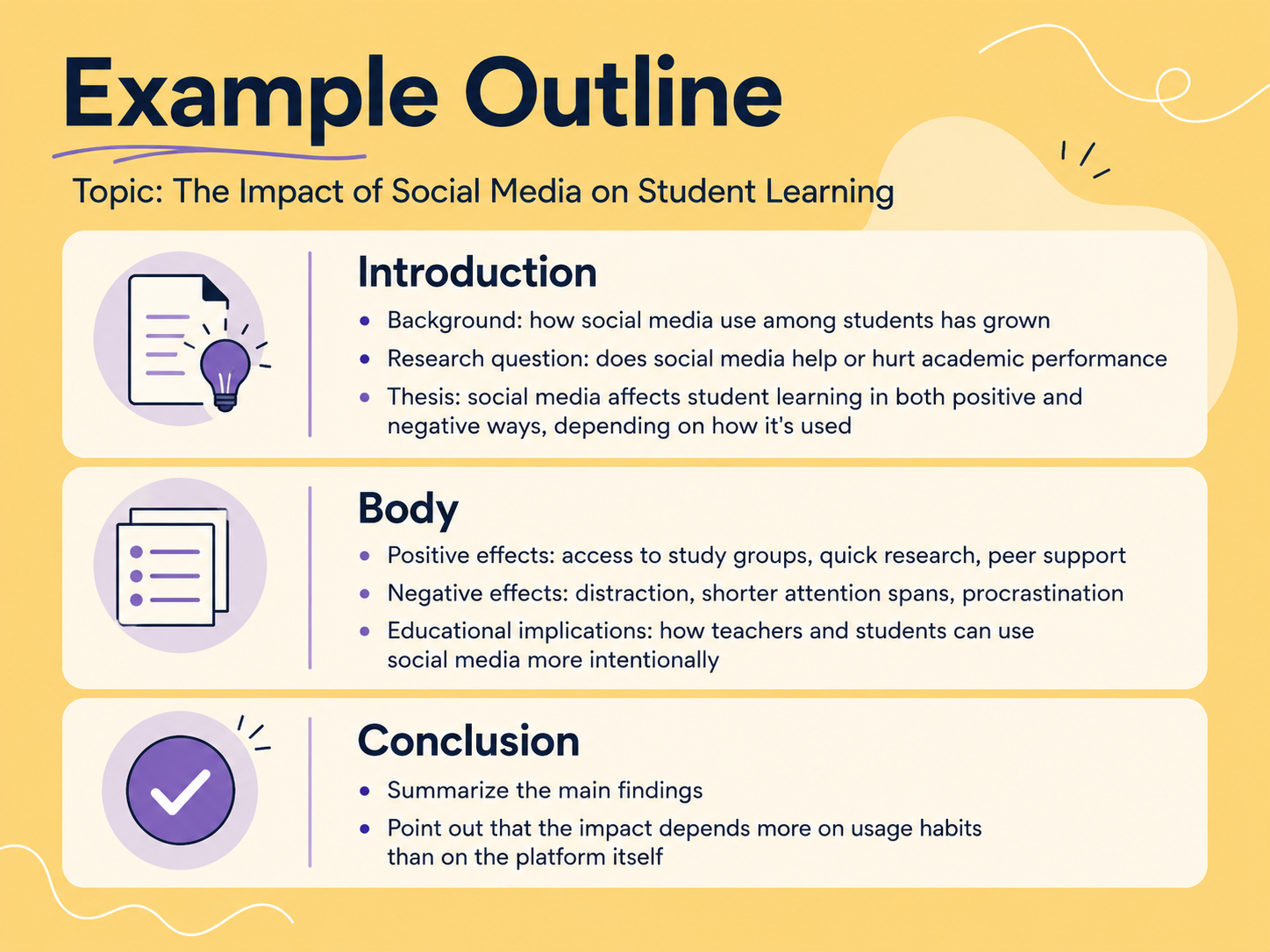
This isn't a term paper sample to copy — your own outline should reflect your specific sources and argument. But it shows how a broad topic turns into a workable structure once you've picked an angle.
Some professors ask for a proposal before you begin. If you need help with how to write a term paper proposal, keep it short: state your topic, explain why it matters, and outline your research plan in one page. This gives your professor a chance to approve your direction before you invest hours in research.
A good proposal also forces you to clarify your own thinking early — if you can't summarize your topic and approach in one page, it's usually a sign the topic still needs narrowing. Include a working thesis, even if you expect it to change, along with two or three sources you already know you'll use. That shows your professor the topic is researchable, not just an idea.
Formatting rules vary by style guide, but most professors expect the basics below. Learning how to format a term paper in APA style means following these standards closely:
One-inch margins on all sides
Double-spaced text, including references
12-point Times New Roman or Arial font
Title page with course name, date, and instructor
In-text citations matching your reference list exactly
Always check your assignment sheet first. Professors sometimes adjust standard assignment formatting guidelines, and small formatting mistakes are an easy way to lose points on an otherwise strong paper. It's worth setting up your document's formatting before you start writing rather than after — fixing spacing and margins across a finished ten-page paper takes far longer than starting with the right template.
A history term paper leans on primary sources: letters, speeches, government records, or newspaper archives from the period you're studying. Build your argument around what these sources reveal, not just what textbooks say about them. A paper built entirely on secondary sources — books and articles written about the period rather than during it — tends to read as a summary of other historians' work rather than your own analysis.
Pick a specific event or decision instead of a broad era. "Causes of the 1929 stock market crash" works better than "The Great Depression" as a whole topic — it gives you room to dig into cause and effect instead of summarizing decades of history in a few pages. Once you've chosen a specific event, look for primary sources close to that moment: contemporary newspaper coverage, official records, or firsthand accounts, which give your paper the kind of specific, original evidence a general history textbook can't.
If you're short on time, learning how to write a term paper fast starts with skipping the blank-page introduction. Write your body sections first, since you already know what you want to argue from your outline. Save the introduction and conclusion for last, once the paper's direction is clear and you can summarize it accurately in a few sentences.
Set a timer for focused writing blocks, like 45 minutes on, 10 minutes off. Momentum matters more than perfection in a first draft — you can fix weak sentences during revision, but you can't revise a page that's still blank. If you're truly tight on time, prioritize getting a complete draft down over polishing individual sentences; a rough but complete paper is easier to fix than a polished but unfinished one.
Students often struggle with research, structure, and deadlines when completing complex assignments. Professional academic assignment help can provide guidance when the workload becomes difficult to manage.
Starting without an outline. This usually leads to a scattered argument that jumps between points instead of building on them, and it's often the reason a paper feels disorganized even when each individual paragraph is well written.
Using unreliable sources instead of academic journals or books. Weak sources make your argument easy to dismiss, no matter how well it's written, since a grader will question the evidence before they consider the analysis.
Quoting too much instead of analyzing evidence. A paper full of quotes reads like a summary, not an argument, and it signals that the writer hasn't fully processed the material.
Writing the introduction first, before the argument takes shape. This often means rewriting it entirely once the body sections are done, since the argument you end up making rarely matches the one you planned to make on page one.
Skipping proofreading after a late-night writing session. Small errors are easy to miss when you're tired, and they add up fast in a grader's eyes, even when the underlying argument is strong.
Writing a term paper gets easier once you break it into stages: topic, research, outline, draft, and revision. Each step builds on the last, so skipping ahead usually costs you more time than it saves.
Some students understand the process but still struggle with deadlines, research, or organizing a long academic paper. In those cases, working with an experienced academic writer can help you move forward while keeping control over the final result.
Most term papers run 1,500 to 5,000 words, depending on your course and instructor. Always check your assignment sheet for the exact requirement.
Plan for one to two weeks, including research, outlining, drafting, and revision. Starting early avoids the stress of rushing every section at once.
Five to ten quality sources usually cover a standard term paper. Longer or graduate-level papers may need more.
Three things: the topic, a bit of background, and your thesis. Start with a sentence that tells the reader what the paper is about, add one or two sentences of context, then end with a clear thesis statement. Keep it short — most introductions run 100 to 150 words.
It's possible, but risky. Skip deep research and go straight to sources you already trust. Build a short outline, then write body paragraphs first and save the intro and conclusion for last.
A term paper is assigned once per term and covers course material broadly. A research paper can be assigned multiple times and often focuses on original data or a narrower question.
Can’t handle all the homework?
Geeks are here 24/7 and can help you make the most out of your study time!

Get expert help now
Testimonials
He tries to do everything perfectly and always meet customers' requirement. I recommend this writer to all the people who want perfect work.
Best writer ever. never see such a responsible writer. He tries to do everything perfectly and always meet customers' requirement. I recommend.
Your company is the first one I have had a pleasant experience with that was able to meet my academic writing needs. Thank you!